

Nonkilling Research Program
Nonkilling Research Commiteees
Nonkilling Research Committees on various areas of knowledge act as consultative bodies to promote the advancement of interdisciplinary scientific evidence on the possibilities of nonkilling societies. These Committees provide creative input on research agendas, academic events, courses and publications. Over 700 scholars are currently involved and researchers from all disciplines are welcome to participate. Learn more…
Exploratory Colloquia
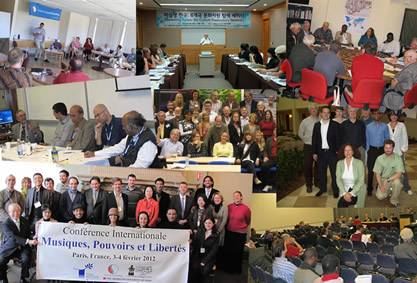 CGNK organizes numerous exploratory seminars and colloquiums where nonkilling is linked with an array of fields and topics such as education, environment, media, arts, security, futures, leadership, gender, etc. These colloquiums have been organized in a variety of settings but are now usually celebrated in conjunction with major conferences of a certain field of knowledge to attract participants and minimize costs, bringing together a group of prominent scholars from diverse theoretical, empirical and methodological approaches and also different academic and geographical backgrounds.
Some examples are the Nonkilling Neuroscience Exploratory Colloquium (Philadelphia, July 2009), the Nonkilling Political Science: Critical Evaluation panel at the 21st World Congress of Political Science (Santiago de Chile, July 2009), the Nonkilling Korea: Six Culture Exploratory Seminar (Seoul, August 2010), the Protecting Sacred Spaces and Political Science Does Not kill! conference and seminar in Thailand (December 2009 and May 2010), the two editions of the Interdisciplinary Seminar on Nonkilling Research at the University of Hawaii (June 2009 and May 2010), Nonkilling Societies Exploratory Colloquium in conjunction with the American Anthropological Association annual meeting (Montréal, November 2011), the “The Bio-Social Bases for Nonkilling and Nonviolent Behavior” Workshop (Leiden, The Netherlands, May 2014) or the Nonkilling Balkans Forum (Sarajevo, Bosnia, August 2014). Reports on some of these events are available in the news section below or in our books page.
Some of the envisioned topics for future seminars are: Nonkilling and gender relations; Nonkilling and education; Nonkilling and economics; Nonkilling and the media; Nonkilling, science, and technology; Nonkilling Religions and Humanist Philosophies; Nonkilling and the arts; Nonkilling and sports; Nonkilling and the professions; the Role of the military and police in nonkilling social transformation.
Such exploratory gatherings are design to make CGNK and larger circles capable of responding effectively to calls for nonkilling action from crises to local, national and international transformations. Envisioned models include:
- Multidisciplinary Convergence of Nonkilling Knowledge. Convene about 20-25 representatives of Nonkilling Research Committees and other scholars for 2-5 days seeking to integrate their knowledge, map nature of a generic Nonkilling Society, and identify knowledge gaps.
- Systems Theory Perspective on Nonkilling Social Change. Convene participants in (1) with 5- 10 applied systems theorists (a) to explore implications of nonkilling knowledge for social system change and (b) identify strategic priorities for leadership actions in various sectors most likely to contribute to total system change.
- Leadership for Nonkilling Social Change. Convene 20- 25 leaders from various sectors of society, with representative of (1) and (2), and invite them to consider what implementing actions could/should be taken on the basis of their experiences and ambitions.
- Guidelines for Nonkilling Leadership. Convene skilled educators, trainers, lucid writers to produce manual or handbook of generic guidelines (creatively adaptable in various cultures) for leader and follower actions in and among various sectors. Conceive everyone a leader; everyone a follower. Draw upon knowledge gained in (1), (2) and (3).
- Follow-up A. Global Nonkilling Leadership Academies. Employ these constantly revised Guidelines as basic text for curriculum.
- Follow-up B. Evaluation Research and Consultation. Create standing programs for (1) interdisciplinary research teams to evaluate applied nonkilling initiatives, and (c) consulting teams to advise on implementing actions.
Research Portal and Repositorium
 Over 600 scholars in 300 academic institutions in 73 countries have joined in 19 disciplinary research committees that are contributing to a scientific paradigm shift from acceptance of killing to discover and apply nonkilling knowledge. This is the largest network of scholars dedicated to advancing research to prevent and reduce killing from every discipline: from anthropology and history to physics and engineering, from economics and psychology to education and the arts, from neuroscience and futures to sociology and security.
CGNK is seeking to enhance the potential of this growing network through a Research Portal where research committee members and other scholars can interact and share their work with the rest of the academic community and the general public. The portal will include highlights on books, articles, dissertations, courses, scientific events, and reseach projects linked to nonkilling enabling collaborative work. A repositorium will also enable easy access to relevant knowledge, including dissertations and publications in general.
UNESCO Unitwin Network for Nonkilling Research
CGNK seeks to engage its academic partners (currently from more that 300 higher education institutions) in establishing UNESCO Chairs focused on specific aspects of nonkilling and a global UNESCO Unitwin Network for Nonkilling Research.
UNESCO’s envisions its Chairs and Unitwin Networks “as ‘think tanks’ and ‘bridge builders’ between the academic world, civil society, local communities, research and policy-making.” The Network will be the first to focus on the promotion, study and application of nonkilling at the higher education and research levels, seeking the effective application of nonkilling alternatives in different contexts and communities, serving as a reference point toward the establishment and reinforcement of networks and partnerships with education institutions, religious institutions, NGOs, indigenous nations and groups, governments, community leaders and individuals across the globe.
The 8th World Summit of Nobel Peace Laureates produced a significant document known as the “Charter for a World Without Violence.” Besides adhering to the World Health Organization’s description of violence as a “preventable disease, Nobel Laureates emphasized a global need “To address all forms of violence we encourage scientific research in the fields of human interaction and dialogue, and we invite participation from the academic, scientific and religious communities to aid us in the transition to nonviolent, and nonkilling societies”. CGNK’s research component seeks to follow this call to action.
Nonkilling Research News
- New CGNK book published: Nonkilling Relationships
- New book! Peaceful Societies: Alternatives to Violence and War, by Bruce Bonta
- The Challenges and Transformative Experiences of Promoting Nonkilling with Anti-Nuclear Weapon Activists and Realists
- Yanomami in the Amazon: Toward a more Ethical Anthropology beyond Othering
- Is Nonkilling Literature Possible?
- Youth, Violence and Peace: Experiences from Cali and Medellín
- “Nonkilling Anthropology” book launched
- Nonkilling Responses to Climate Crisis Conference in Vasa, Finland
- Nonkilling Paradigm book published by Springer
- «Give Nonkilling a Chance» book released in Delhi