
Education & Training Programs
Global Nonkilling Studies Program
 CGNK is working to establish an associated master’s degree-level (120 credits) academic program to disseminate and advance nonkilling knowledge at the Higher Education level. The program modules will be developed through CGNK’s Research Committees and CGNK book series (under creative commons license) used as core learning materials, which will be made available through an online platform free of cost.
Each of CGNK Research Committees will jointly prepare a syllabus for their associated Course module and one or more Research Committee members will be assigned as Course Tutors with the responsibility of implementing the syllabus and guiding the students through the course assignments and Program Dissertation.
The program will offer two itinerary options: a non-credit itinerary and a credit itinerary. Within the first option, a Self-learning Program will be offered free of cost, were students will have full access to all program resources but will not be required to complete course assignments or prepare a Program Dissertation and will not be entitled to tutorship or certificate of achievement. Alternatively, non-credit students can enroll in a Tutored Program for a small fee, which will provide access to course Tutors and the possibility of obtaining a CGNK issued certificate after completing all course assignments and a final dissertation.
CGNK will also build partnerships with accredited universities around the world to jointly implement the Global Nonkilling Studies Program as recognized credit courses. Wile the Course structure will remain essentially the same, some aspects will be adapted to meet local laws and regulations providing access to official graduate-level diplomas (Certificate or Master’s degrees). Credit programs will still be taught through the virtual online platform but some universities may require a number of on-site credits. Details on specific aspects of the Program implementation in each institution (such as fees, accreditation or on-site activities) should be consulted with the Local Coordinator.
Initial Courses (Modules) will include:
- Introduction to Nonkilling Studies (12 credits) Download «Nonkilling Global Political Science (revised edition, 2009)» [587.32 KB] and Download «Toward a Nonkilling Paradigm» [1.41 MB]
- Nonkilling Political Science (6 credits) Download «Nonkilling Global Political Science (revised edition, 2009)» [587.32 KB]
- Nonkilling Anthropology (6 credits) Download «Nonkilling Societies» [1.57 MB]
- Nonkilling Psychology (6 credits) Download «Nonkilling Psychology» [1.71 MB]
- Nonkilling Security (6 credits) Download «Nonkilling Security and the State» [1.24 MB]
- Nonkilling Linguistics (6 credits) Download «Nonkilling Linguistics: Practical Applications» [920.50 KB]
- Nonkilling Geography (6 credits) Download «Nonkilling Geography» [843.75 KB]
- Nonkilling Science and Technology (6 credits) Download «Engineering Nonkilling: Scientific Responsibility and the Advancement of Killing-Free Societies» [751.10 KB]
- Nonkilling Media Studies (6 credits) Download «Nonkilling Media» [2.38 MB]
- Nonkilling Futures (6 credits) Download «Nonkilling Futures: Visions» [1.17 MB]
- Nonkilling History (6 credits) Download «Nonkilling History: Shaping Policy with Lessons from the Past» [1.11 MB]
- Nonkilling Leadership (6 credits) Download «Global Nonkilling Leadership Forum Book of Proceedings» [2.03 MB]
Available soon
Nonkilling Education (6 credits); Nonkilling Economics and Business (6 credits); Nonkilling Arts (6 credits); Nonkilling Spiritual Traditions (6 credits); Nonkilling Thought – Philosophy (6 credits); Program Dissertation (21 credits).
Students shall prepare one essay for each course (to be graded by the Course Tutor) and one Program Dissertation, to be guided and graded by one or more Tutors depending on the areas of knowledge tackled in the essay. Outstanding essays, following recommendation by the Tutor(s), will be considered for publication in CGNK’s Global Nonkilling Working Papers series, made available online and on print. Fees will be used to provide stipends to tutors, develop learning materials, maintain the online platform and cover administrative expenses.
Leadership Academy and associated Youth Network
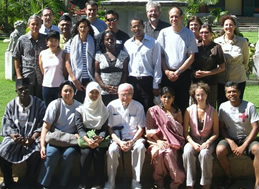 CGNK considers building and supporting the capacity of young leaders an essential part of affecting change over time and making progress toward eliminated killing. As such, CGNK convenes an international nonkilling leadership academy each year, and is developing other leadership initiatives as well, such as regional leadership workshops. CGNK now has 42 Fellows in over 20 countries. So far, three Global Nonkilling Leadership Academies have been conduced (2009, 2010 and 2011) including participants from Canada, China, Colombia, Germany, Guatemala, Haiti, India, Iran, Ireland, Israel, Italy, Kenya, Liberia, Nepal, Palestine, Philippines, Rwanda, Thailand, Trinidad,the United States and Western Sahara.
The Global Nonkilling Leadership Academy is intended to provide a select group of promising young leaders (from different fields, faiths and backgrounds) a life changing experience related to the real and much needed possibilities of a world where killing is no longer taken for granted. The Academies are regular two week programs comprised of 15 participants. Participants are nominated by past Nobel Peace Laureates, as well as drawn from organizations and networks partnering with CGNK, and in future editions must have previously taken the online Global Nonkilling Studies Program to qualify. A “Youth, Leadership and Initiative for Nonkilling” (YouthLiNK) alumni network has been established for continuing relatioships and support.
Read the full report from the first annual Leadership Academy or watch a short six-minute video introduction.
School Guide and Curricula and associated School Network
The need for simplified, condensed and easy-to-apply nonkilling educational materials has been made clear. Bringing nonkilling to basic education will help improve the Center’s ability to convey the essential message of nonkilling to the younger segment of formal education. This project involves developing nonkilling educational materials for primary school children (other grade levels to be added in the future). The project consists of developing one or two booklets (either one for teachers and one for students or one single volume) in which the idea of nonkilling is laid out for its discussion at a primary school level, containing a teacher’s guide and activities (including stories, songs, exercises, etc). CGNK will develop Primary and Secondary School Guides and Curricula (to be translated to a number of languages) and an Associated Nonkilling School Network were the school communities that implement it share their experiences and help improve future editions, cultural adaptations and new materials and techniques.
Download «School Guide Units description» [64.25 KB]
Translations and Publications
CGNK publications are a cornerstone in the creation and development of the nonkilling concept and, subsequently, its application. Expanding its diffusion across the world will multiply the possibilities of new partnerships, actions, educational initiatives and research developments. Democratizing access to nonkilling knowledge, through the internet in a free open basis and through the strategic promotion of translations to other world languages, is part of the Center’s wider mission. The introduction of nonkilling into conflict torn societies and countries with severe risk of latent conflicts developing to outburst of killing also has strategic importance for the CGNK.
Nonkilling Hawai‘i Consortium
CGNK will promote a Hawai‘i-based Consortium to promote the vision of a Nonkilling Hawaiian Islands envisioned as a working model for global nonkilling that will include research/discovery, education/training, and policy/action. The Consortium will be made up by governmental, non-profits, and business representatives and will also support the establishment and protection of a Nonkilling Hawai‘i Aloha Peace Museum home to CGNK’s headquarters.
Other Nonkilling Learning Resources
University Syllabi featuring Nonkilling
- Download «Aggression, War and Peace (Spring 2010 [Fall 2012 updated syllabus])» [186.24 KB] , Prof. Leslie E. Sponsel, University of Hawai’i.
- Nonviolence in Education (Spring 2011), Prof. Hayal Köksal, Boğaziçi Univesity (Turkey).
- Economic Aspects of Armed Conflict, War, and Peace (Spring 2010), Prof. J. Brauer and Prof. H. van Tuyll, Augusta State University.
- The Future of Political Systems (Spring 2010), Prof. Jim Dator, University of Hawai’i.
- Introduction to Political Science (Fall 2009), Prof. Vincent K. Pollard, University of Hawai’i.
- English Writing (Spring 2009), Prof. Mark Shadle, Semester at Sea, University of Virginia.
- Analysis of War and Peace (since 2006), Prof. Tim McElwee, Manchester College.
- Seminar on the Nature and Scope of International Studies (since 2004), Prof. N. Morales, University of the Philippines.
- Introduction to Politics (since 2004), Prof. Eric Giordano, University of Wisconsin – Marathon County.
- The Economics of Conflict & Security (since 2001)>, Prof. Geoff Harris, University of Natal.
Education and Training News
- Caribbean Center for Nonkilling, Peace, and Conflict Studies established in Haiti
- First International Certificate Course on Nonkilling Political Science Completed
- The Nonkilling Approach within Peace Studies online seminar
- Certificate Course in Peace, Nonkilling in the World Religions
- Jagran Lakecity University at Bhopal, Launches Centre for Nonkilling and Peace
- Nonkilling Featured at Prague Impact Summit
- Nonkilling at Jaume I University Master in Peace, Conflict and Development
- Nonkilling at the Center for Nonproliferation Studies, Monterey
- Applications for Glenn D. Paige Memorial Award Open
- Journal of Peace Education Special Issue on Nonkilling